Argentine ant remediation in Stockton requires an understanding of how Linepithema humile interacts with Central Valley moisture patterns. Unlike native ant species that defend isolated territories, Argentine ants form…
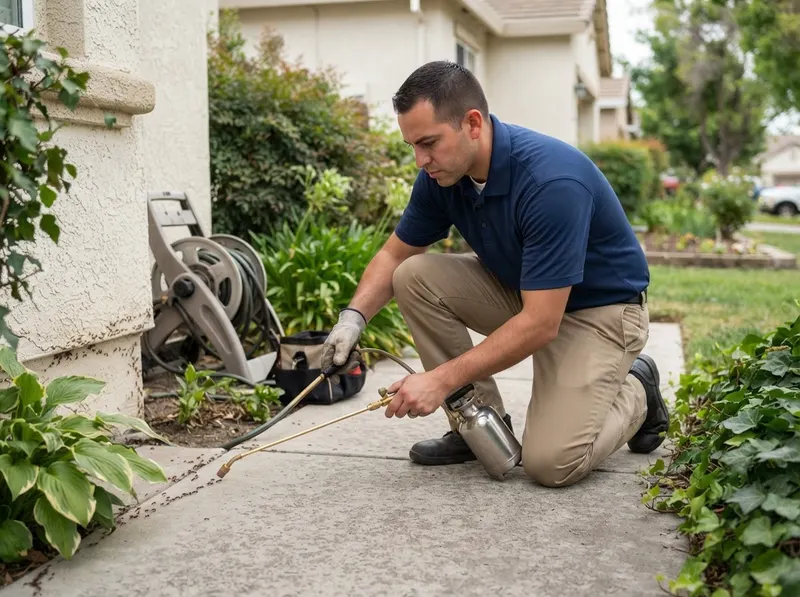
Argentine ant remediation in Stockton requires an understanding of how Linepithema humile interacts with Central Valley moisture patterns. Unlike native ant species that defend isolated territories, Argentine ants form cooperative supercolonies containing hundreds of reproductive queens across interconnected sub-nests. When homeowners use retail repellent sprays bought at retail garden centers, the fast-acting chemical irritates foraging worker ants and induces colony budding, a defensive biological reaction where satellite queens disperse across foundation joints, wall voids, and plumbing chases, turning a single kitchen trail into five isolated interior infestations. In Stockton, this dynamic accelerates during hot dry summers when worker ants track indoor moisture sources, and during winter rainstorms when rising water tables near the California Department of Water Resources monitoring channels push subterranean colonies upward into dry subflooring.
Effective colony eradication relies on the biological foraging mechanism known as trophallaxis, where sterile worker ants carry micro-doses of non-repellent toxicant back to feed subterranean queens. Liquid and granular baits formulated according to University of California Statewide Integrated Pest Management Program guidelines maintain palatability for 7 to 14 days, allowing the chemistry to saturate the entire reproductive tier of the supercolony before worker mortality begins. Concurrently, certified field technicians apply non-repellent exterior perimeter barriers along foundation footings, crawlspace vents, and perimeter expansion joints. These barrier materials align with standards registered under the California Department of Pesticide Regulation, delivering undetectable contact toxicity that worker ants track into nested soil zones around landscape curbs, river-rock beds, and concrete flatwork.
Geographic conditions across Stockton directly dictate where subterranean nests anchor. Properties in Lincoln Village West and Brookside situated along San Joaquin Delta waterways frequently experience severe sub-slab colony pressure driven by dense decorative landscaping and automated sprinkler heads. Further inland, homes throughout Morada, Spanos Park, and Bear Creek often face heavy infestations nesting beneath compacted clay loam and irrigated orchard margins. To establish permanent control without runoff into municipal storm basins, exterior applications follow safety buffers enforced by the Central Valley Regional Water Quality Control Board. Structural inspections identify bridging vegetation such as oleanders, fruit trees, and ivy beds that allow trailing workers to bypass foundation bands and enter through roof vents or stucco weeping screens, where tree trimming guidelines from the International Society of Arboriculture help property owners eliminate aerial bridging paths.
Restoring residential safety inside living spaces involves systematic interior void placement rather than broadcast aerosol applications that leave persistent residues. Field technicians evaluate sensitive indoor spaces following environmental health guidelines from the U.S. Environmental Protection Agency and structural pest handling guidelines maintained by the Structural Pest Control Board of California. Technicians place tamper-resistant bait stations beneath sinks, behind kitchen kickplates, and adjacent to laundry utility access points, isolating chemical agents away from household pets and food prep counters. Safe interior bait handling mirrors indoor air quality protocols established by the National Institute for Occupational Safety and Health and domestic pesticide storage practices outlined by the National Pesticide Information Center. Service records, active ingredient listings, and treatment boundaries are provided directly to property owners following completion. Every remediation visit is carried out by licensed local service crews dispatched through BlueHaven Pest Crew, avoiding unvetted subcontractor rotations or compulsory long-term contract lock-ins.
Every job gets a firm, written price after a free on-site visit.
For standards, safe disposal, and service guidance on PEST CONTROL SEVICE in Stockton, CA, useful references include U.S. EPA, ENERGY STAR, U.S. Dept. of Energy, Consumer.gov, U.S. Census Bureau, and Google Maps. General consumer and small-business resources are available from USA.gov, Better Business Bureau, FTC Consumer Advice, U.S. Small Business Administration, and Ready.gov.
Tell us about your argentine ant remediation job in Stockton and we'll send a clear, written quote, usually the same day.
 BlueHaven Pest Crew